Begin with the story and its singer
Yakshagana is a theatre tradition in which singing, percussion, dance, spoken dialogue and elaborate costume work together. It is strongly associated with coastal Karnataka and neighbouring Kasaragod. The painted face and towering headgear may catch the eye first, but the story becomes clearer when you also follow the singer and listen to how the actors answer one another.
A performance often takes an episode, or prasanga, from the Ramayana, Mahabharata or other narrative traditions. You do not need to know an entire epic beforehand. Learn which characters appear, what each wants and what dispute brings them together. Those three pieces of information make an unfamiliar scene much easier to follow.
The Bhagavata is the leading singer and a central guide to the action. A mela is a performing troupe; Karnataka Tourism names Saligrama, Dharmasthala, Mandarthi and Perduru among well-known examples. The troupe's name, the prasanga and the principal artists tell you more about a programme than a poster simply advertising a cultural show.
A written framework with room for live speech
The relationship between verse and speech is one of Yakshagana's great pleasures. A prasanga supplies the narrative and sung material, while actors develop spoken exchanges within the situation. A familiar story can therefore remain interesting across different casts and evenings. The audience can appreciate both the inherited episode and what a particular artist makes of it.
K. Shivarama Karanth's essay for the NCPA describes the cultivation of extempore dialogue through long experience. He also points to story clues in titles: kalga commonly signals conflict or battle, while kalyana and parinaya indicate a marriage theme. A title such as Karna-Arjuna Yuddha announces a confrontation whose emotional interest extends beyond discovering who wins.
For a first performance, listen for the argument within the action. A character may defend an obligation, challenge another person's judgment or justify an apparently difficult decision. The exchange matters even when the plot is familiar. Yakshagana gives a story space to become a debate between distinct voices, rather than merely a sequence of events acted out in costume.
Tenkutittu, Badagutittu and a regional map
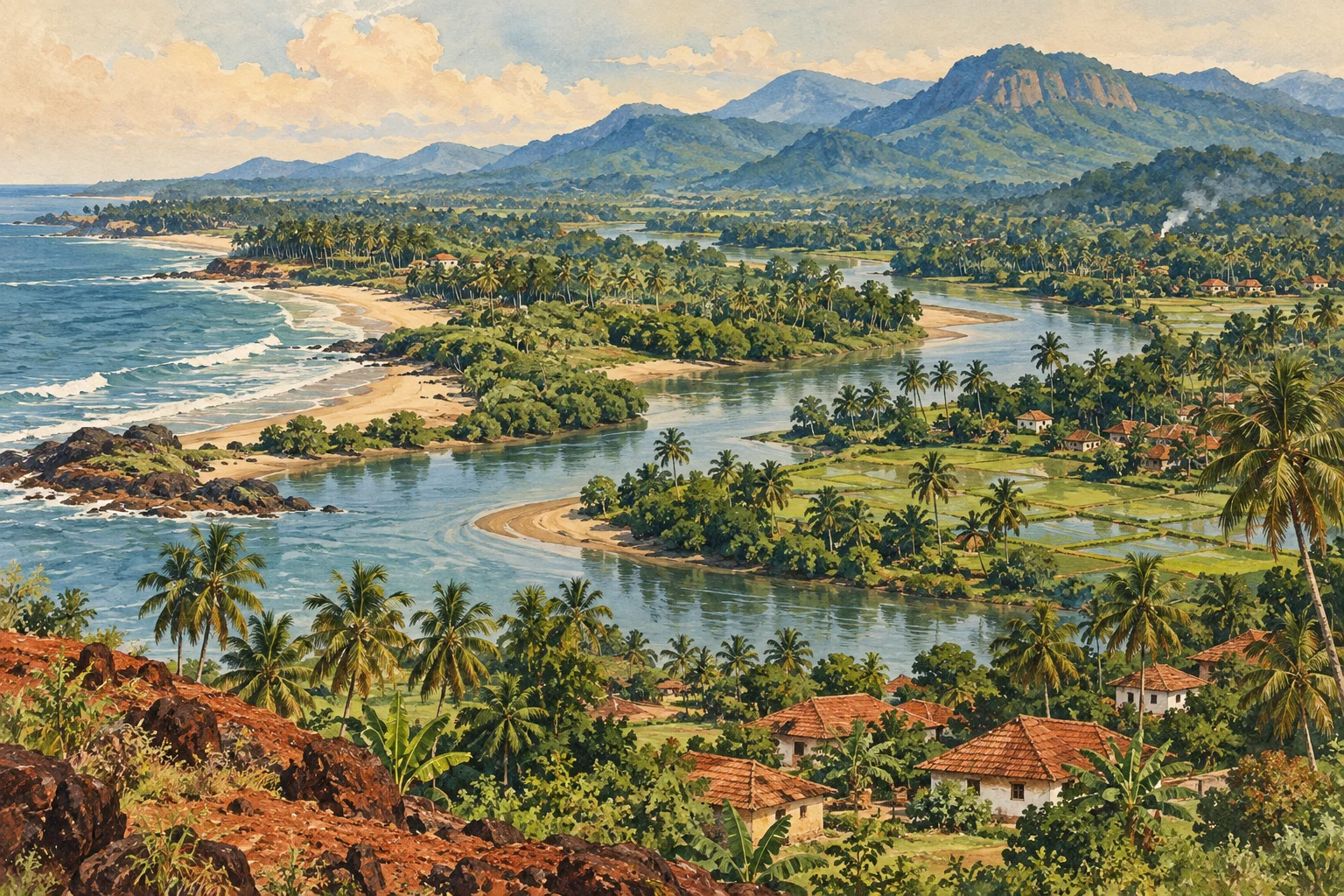
Coastal Yakshagana includes recognisable regional styles. In Manorama B.N.'s account, Tenkutittu is associated broadly with the southern zone around Mangaluru and Kasaragod; Badagutittu with Udupi, Kundapura and adjoining areas. She also identifies a farther northern Badabadagutittu tradition in Uttara Kannada. These names describe connected performance traditions, rather than administrative borders that artists cannot cross.
The broader distinction between western Paduvalapaya and eastern Moodalapaya also appears in discussions of Yakshagana. A coastal guide concentrates on the former, but the larger vocabulary prevents the mistake of assuming that every use of the word refers to one identical stage practice.
At a live event, knowing the style gives you a starting point for noticing the treatment of movement, costume and musical accompaniment. It is more useful to compare a particular passage performed by identified artists than to rank entire styles after seeing one short clip. The Tulunad region guide supplies the geographical background to these southern coastal connections.
Hear how percussion and movement meet
The ensemble gives the performance its energy and shape. Dsource's documentation by NID Bengaluru identifies the maddale, a drum played with the hands; the chande or chende, struck with sticks; tala cymbals; and a sustained pitch reference or shruti. These sounds have different jobs. Listen for the contrast between the singer's phrase, the drum's articulation and the actor's response through the feet and body.
A useful first exercise is to follow one transition all the way through. Notice when a song begins, how the dancer takes up its rhythm and how the scene moves towards speech. Manorama describes a rhythmic closure called muktaaya, which helps articulate these transitions. A sudden rhythmic change is therefore part of the dramatic organisation, not simply an invitation to play louder or faster.
You need not identify every raga or tala to hear coordination. Watch whether an actor holds a pose through a musical phrase, accelerates into a movement or pauses before speaking. This makes the ensemble visible as a set of responsive artists, rather than background music accompanying a solo dancer.
What costume and the stage let you see
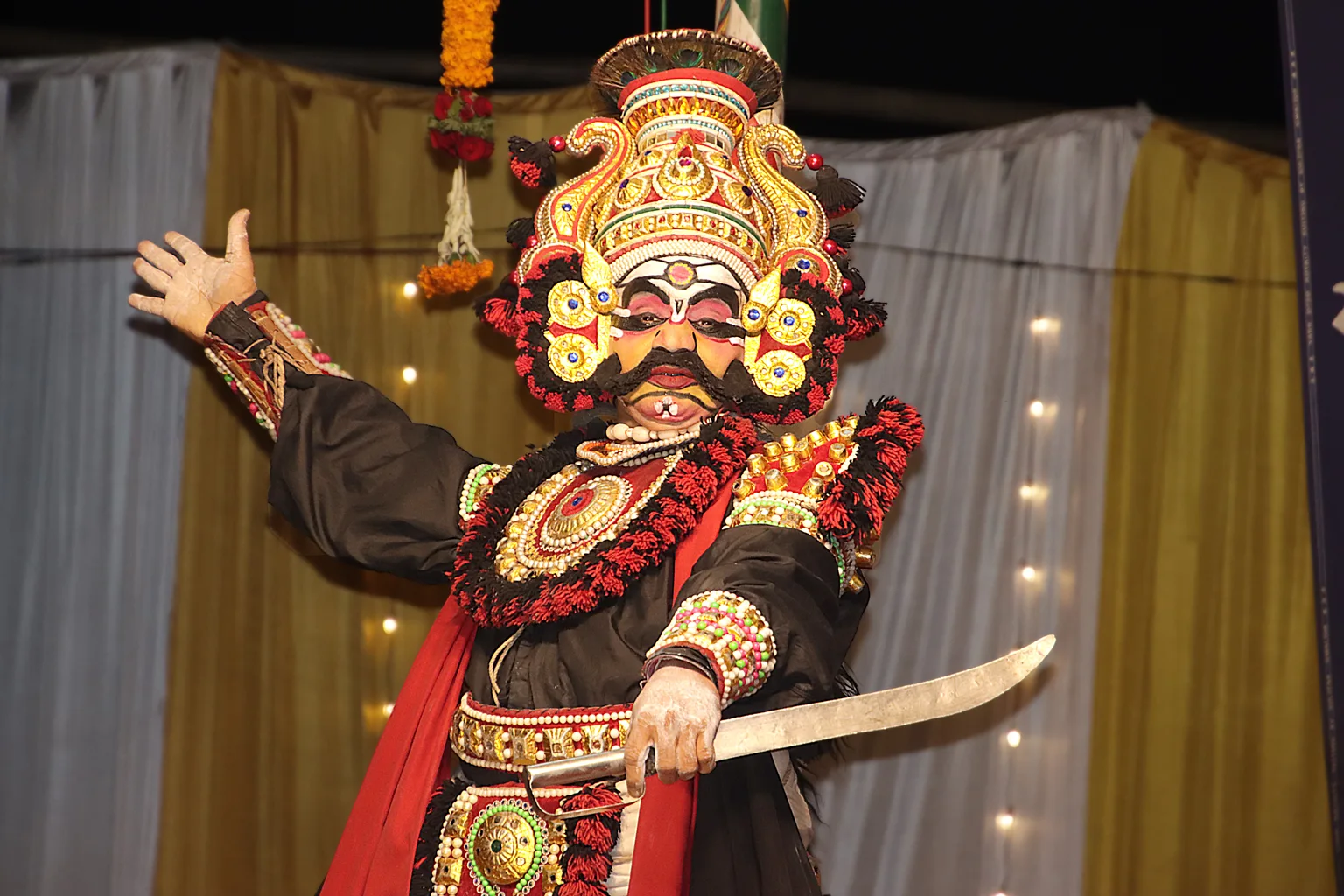
Yakshagana's visual scale belongs to its theatre. Headgear, ornaments, face painting and strongly defined silhouettes allow characters to make an immediate impression. NID's design documentation relates this enlarged appearance to open-air presentation and night lighting. The effect is deliberately unlike everyday dress: the stage establishes a world of extraordinary characters before they begin to argue or act.
A costume photograph cannot show everything that makes the design work. Movement changes the silhouette; turning the head changes what catches the light; a held stance can give a figure weight and authority. Looking at the whole body explains more than treating the painted face as an isolated pattern.
The held curtain, or tere, can also make an entrance into an event. A character may be revealed gradually rather than simply walk into view. Follow the audience's attention as feet, headgear and face become visible. That controlled introduction gives a performer time to establish presence. The preparation space, often called the chowki, belongs to the artists' working and ritual arrangements rather than to the public seating area.
A history of continuity and deliberate change
There is no need to assign Yakshagana a single birthday to appreciate its history. Karanth discusses earlier names such as Bhagavatara ata and Bayalata and identifies a substantial written dramatic tradition extending back several centuries. References to an old musical term and the history of today's complete stage form are different kinds of evidence; they should not be compressed into one precise founding date.
Change also comes from artists working inside the tradition. Karanth describes his own experiments with dance drama, including productions that reduced reliance on spoken dialogue. His account shows a practitioner investigating how music, movement and dramatic meaning could work differently together. It is evidence of an artistic choice, rather than a rule for every mela.
That history helps explain why contemporary presentations differ in length and setting. A complete overnight performance, a shorter evening programme and a teaching demonstration offer different amounts of narrative development. A brief introduction can be a useful beginning, while a longer performance allows more time for character, argument and the cumulative relationship between music and action.
Talamaddale puts the argument in the foreground
Talamaddale offers a related way to encounter the stories through voice and interpretation. IGNCA's account describes seated artists taking character roles alongside a Bhagavata and instrumental accompaniment. The emphasis falls on oratory and the participants' command of the narrative. Instead of waiting for a costumed entrance or a large dance passage, the listener follows how a character thinks and speaks.
An IGNCA programme in 2013 presented Girija Kalyana in this form. Its report identifies Kannada as the usual language and describes repertoire from the Ramayana, Mahabharata and Puranas. That documented example is useful because it shows Talamaddale as a complete performance format, not an unfinished rehearsal for a costumed show.
For a learner, the attraction is the sustained exchange of ideas. The same scene can contain affection, pride, persuasion and disagreement. If rapid speech is difficult to follow, learning the story beforehand provides a framework for listening. Talamaddale rewards attention to a speaker's reasoning and timing as much as familiarity with the eventual outcome.
Puppetry offers another encounter with Yakshagana
Yakshagana Bommayatta connects this performance world with string puppetry. Athira S.J.'s documentation of the Kasaragod tradition describes decorated puppets whose articulated bodies are controlled from behind the stage. The figures share the dramatic visual vocabulary of Yakshagana while requiring a different kind of physical skill from the artists who bring them to life.
Her account focuses on K.V. Ramesh and the Sree Gopalakrishna Bommayatta Sangha. It describes the making and dressing of puppets, as well as performances drawing on epic episodes. These are the details that make puppetry understandable as craft and theatre together: a joint must permit movement, the costume must work at the puppet's scale, and each gesture must read clearly to an audience.
Watch the relationship between a puppet's balance and its character. A small turn, a pause or the meeting of two figures can suggest intention. Seeing Bommayatta alongside live-actor Yakshagana reveals how different materials and techniques can serve connected dramatic stories without making one format a substitute for the other.
Training makes the spectacle possible
Yakshagana Kendra Udupi dates its establishment to 1971 under the Government of India's Guru Scheme. Its institutional history names Shivarama Karanth and K.S. Haridasa in the development of the school and records Sode Mutt's contribution of land. This provides a concrete chapter in modern Yakshagana education, alongside the learning that takes place through teachers and performing troupes.
The Kendra's account also explains the effort to combine artistic training with general education. The point is practical: a student needs sustained practice and a viable life beyond a single performance. A large headdress or an impressive movement is the visible outcome of many smaller lessons in rhythm, control, memory and working with other artists.
For a first evening, arrive knowing the prasanga and settle where both the performers and musicians are visible. Follow one complete scene before trying to classify everything. Then return with a new question about a role, a singer or a style. Like Tulu oral literature, Yakshagana becomes richer through repeated listening to identifiable performers.
Research notes
Karnataka Tourism: Yakshagana; Manorama B.N., Sahapedia: Yakshagana, the performance; K. Shivarama Karanth, NCPA Quarterly Journal: The Yakshagana of Karnataka; NID Bengaluru, Dsource: Yakshagana Bayalata Sambrama; IGNCA: Girija Kalyana in Talamaddale, 2013; Yakshagana Kendra Udupi: Institutional history; Athira S.J., Sahapedia: Yakshagana and Yakshagana Bommayatta.
Research checked 7 October 2026. Our editorial approach.