A cultural region, rather than a single district
Tulunad is a useful name for understanding a connected coastal world. It is not the name of a present-day district with a single collectorate, municipal boundary or official population total. The administrative map divides this coast among districts and states; language, family connections and cultural practices do not necessarily stop at those lines. Treating the two maps as identical makes the region harder to understand.
This guide begins with Dakshina Kannada and Udupi in Karnataka and acknowledges cultural connections into northern Kasaragod in Kerala. It does not assign every settlement in those districts one identity. The district administrations themselves describe a multilingual coast. Tulunad is therefore best approached through overlapping relationships: where people speak Tulu, where traditions circulate, where rivers meet the sea and where families maintain a sense of belonging. A person can belong to this regional story without speaking the same language or practising the same religion as a neighbour.
Read the landscape from the sea towards the hills
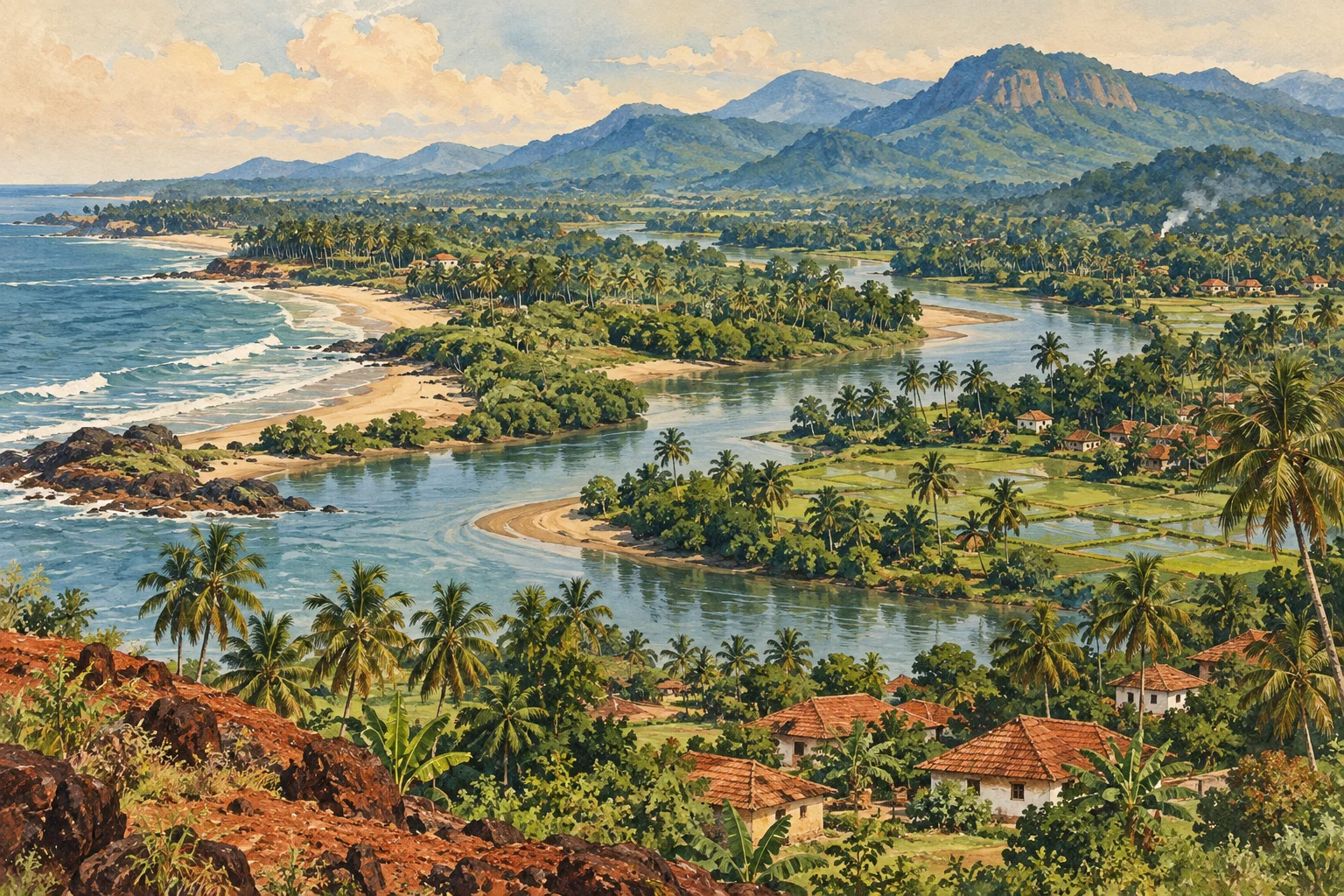
Dakshina Kannada lies between the Arabian Sea and the Western Ghats. Udupi also has a coastal tract, an inland belt of uplands and hilly country towards the east. These broad divisions explain more than a list of beaches can. A settlement beside an estuary, a laterite upland village and a foothill settlement face different conditions even when they share a language or a market town.
The coast and the Ghats should be read together. UNESCO describes the mountain chain as an influence on the southwest monsoon, with moist winds meeting elevated terrain. Water flowing down from inland catchments connects forest, agriculture and the coast. That relationship is a better starting point than imagining two separate attractions, a beach holiday on one side and a forest excursion on the other. Our Western Ghats guide explains the larger ecological setting and why the mountain range extends far beyond Tulunad.
Mangaluru, Udupi and the changing administrative map
Mangaluru is the headquarters of Dakshina Kannada. Udupi district was formed on 25 August 1997 from the former Dakshina Kannada district, initially bringing together Udupi, Kundapura and Karkala taluks. Consequently, a family document that places an Udupi-area village in Dakshina Kannada may be perfectly accurate for its date. An older address is evidence of an earlier administrative arrangement, not necessarily an error.
Mangalore and Mangaluru are names for the same city, while Udupi can mean either the city or the much larger district. These distinctions matter when locating a village, institution or family home. The Mangaluru heritage guide follows the city through its buildings, institutions and waterfront history.
Tulu at the centre of a multilingual region
Tulu is essential to understanding Tulunad, but it is not the only language through which people experience the region. Udupi district tourism material names Tulu, Kannada, Konkani and Beary. The Kasaragod administration describes an even wider multilingual setting that includes Malayalam. These official descriptions establish diversity; they do not tell us that every speaker is multilingual in the same way or that one language belongs exclusively to a single place.
A shared place can therefore carry several names and be described through several languages. Language, religious affiliation and community identity overlap without forming one-to-one categories. Our introduction to Tulu language and script explains the distinction between the spoken language, its writing systems and oral traditions.
Many communities, with histories that meet
Bunts are an important part of this regional story. They are not its only participants. Udupi district material names, among others, Billavas, Mogaveeras, Koragas, Konkani-speaking groups, Brahmin communities and Mangalorean Catholics. Kasaragod’s cultural account also reflects Hindu, Muslim and Christian life. Such lists are illustrative rather than exhaustive, and a district description cannot stand in for the histories that people tell about themselves.
Malpe’s fishing economy, Manipal’s educational institutions and Pilikula’s craft displays reveal different forms of regional work. None represents the whole population. The Bunts community history follows one community within this wider setting, where neighbours may share a market, a language or a landscape while maintaining distinct customs.
Rivers are part of the region’s everyday structure
The Swarna and Sita are among the rivers named in Udupi’s district geography. Swarna also has an everyday civic role: the district disaster-management account identifies the Baje water-supply connection to Udupi. That is a reminder that a river can be a habitat, a source of water and a familiar element of a landscape at the same time. Its importance does not depend on whether it appears in a tourist photograph.
For readers building a mental map, begin with the relationship between a river, its catchment and its mouth. A coastal backwater is connected to processes upstream, while an inland settlement can depend on water systems whose effects are visible at the coast. Administrative boundaries are useful for governance, but they do not contain the whole environmental story. The rivers and estuaries guide brings together the Netravati, Gurupura, Swarna and Sita without treating every waterside location as a visitor destination.
Homes and crafts reveal a different kind of heritage
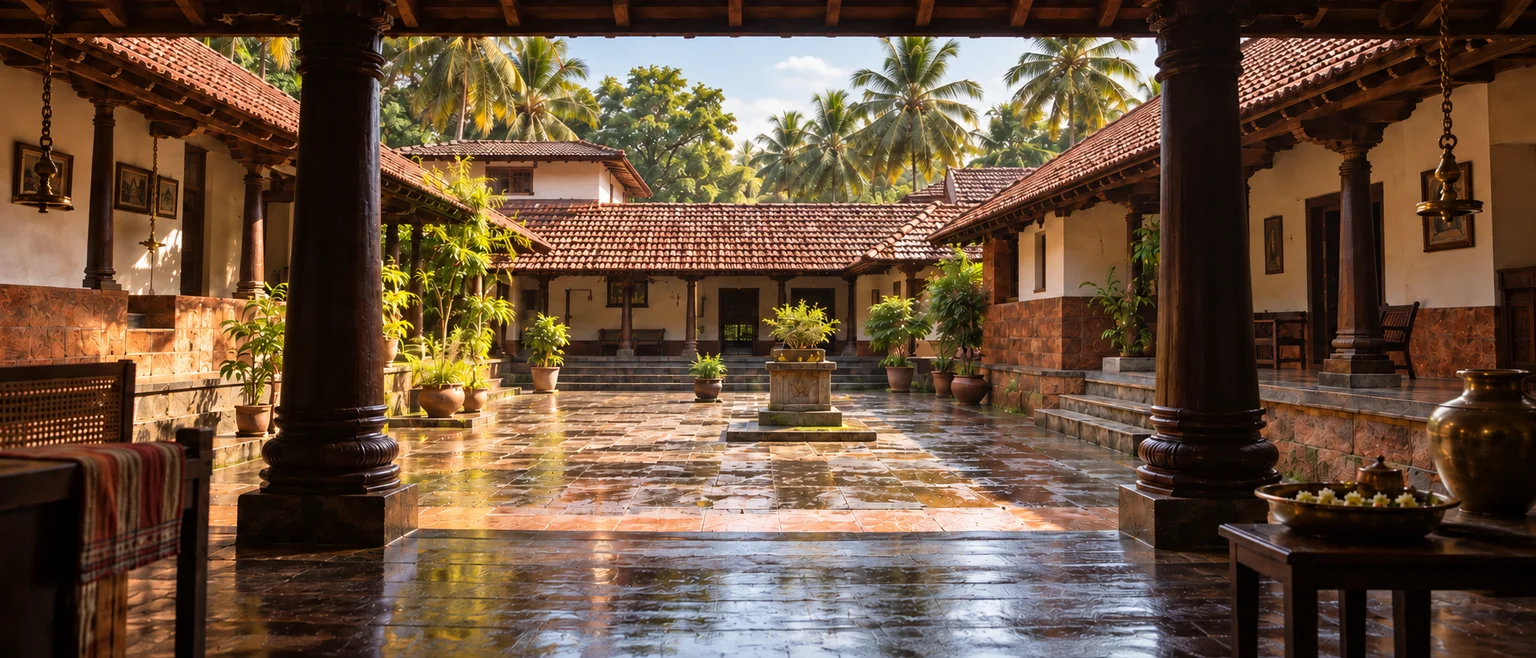
At Pilikula, near Mangaluru, Karnataka Tourism describes a heritage village that presents crafts such as pottery, weaving, carpentry and metalwork. Its Guthu Mane offers another way into the region’s material culture through timber, household objects and domestic space. A museum setting can make these subjects approachable, but it is a curated introduction rather than a complete substitute for the histories of occupied homes.
Timber posts, household vessels and craft demonstrations shift attention from a building’s silhouette to the work that sustained it. A large home needed spaces for several activities, and the objects used within it help make those arrangements legible. Our guide to Guthu houses connects the architecture with household life and social history.
Performance traditions cross the map too
Karnataka Tourism describes Yakshagana as a form combining music, movement, dialogue and elaborate costume, with a performance geography that includes coastal districts beyond the narrowest idea of Tulunad. That wider circulation matters. A cultural form can be central to a place while also belonging to networks that extend outside it. Regional pride does not require drawing an exclusive boundary around the art.
Yakshagana theatre, Daivaradhane and a household celebration such as Bisu Parba have different purposes. Costume and music alone do not make them interchangeable. The Daivaradhane guide introduces a sacred ritual tradition, while the Bisu Parba guide follows a seasonal observance in family life.
Tulu knowledge has an institutional home too
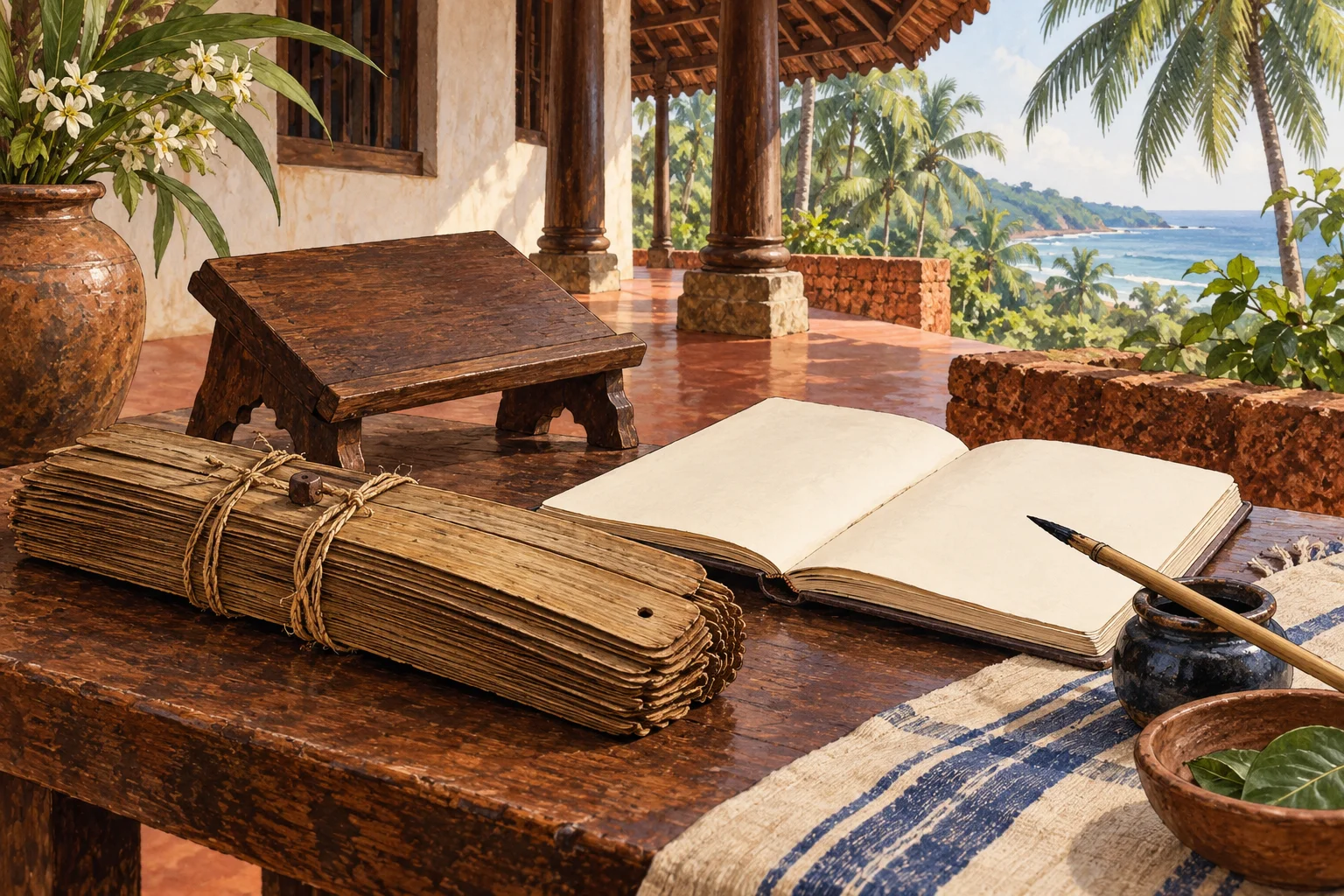
Mangalore University’s Tulu Chair was established in 1992. Its stated work includes language and culture, folk literature, manuscripts and the preservation of oral-epic research materials. That institutional work is an important counterpoint to the idea that regional knowledge exists only as an informal memory of the past. It can be studied, recorded, compared and made accessible while continuing to live in families and communities.
The Chair brings oral literature into conversation with manuscripts and language research. Alongside the coastal setting, this work gives Tulunad a second kind of connection: stories and words can circulate beyond the village where a particular version was learned. The region lives through such relationships as well as through its physical geography.
Research notes
Dakshina Kannada district: About District; Udupi district: About District; Udupi district: Tourism; Udupi district: Disaster Management Plan; Kasaragod district: Culture and Heritage; UNESCO World Heritage Centre: Western Ghats; Karnataka Tourism: Pilikula Village Nisargadham; Karnataka Tourism: Yakshagana; Mangalore University: Shri Dharmasthala Manjunatheshwara Tulu Chair.
Research checked 7 October 2026. Our editorial approach.