What the three names describe
Daivaradhane refers to the worship of daivas in the Tulu cultural region. Bhuta kola and nema are names used for ritual occasions within that wider world of worship. The gathering can bring together oral narrative, music, bodily transformation, offerings and exchanges between a daiva and the people who seek its attention. For participants, its purpose includes a relationship with a sacred presence.
The words are related, but they are not a universal three-step classification. Local usage may distinguish a particular kind or scale of observance as kola or nema. One village's explanation should be kept with that village rather than turned into a rule for the entire coast. Daiva, bhuta and their different English spellings also appear in scholarship and community speech.
A useful way into the subject is to keep four things together: which daiva is being honoured, where the observance belongs, who carries its responsibilities and what the occasion is called locally. These details say more than translating every bhuta as a ghost or every kola as a dance.
A gathering organised around relationships
A ritual occasion has a social geography. The shrine, the household associated with it, the route of a procession and the place where people assemble help organise who meets whom. A family may describe its connection through inherited obligations; another participant may know the occasion through service, performance, devotion or a particular promise.
Miho Ishii's study of Perar provides a precise example. She describes a shrine connected to village guttu houses, priests and Pambada ritual specialists, with an annual neema bringing their responsibilities into action. Her account is useful because it names an actual setting and its participants. It does not treat an entire region as though it had one shrine committee and one ceremonial sequence.
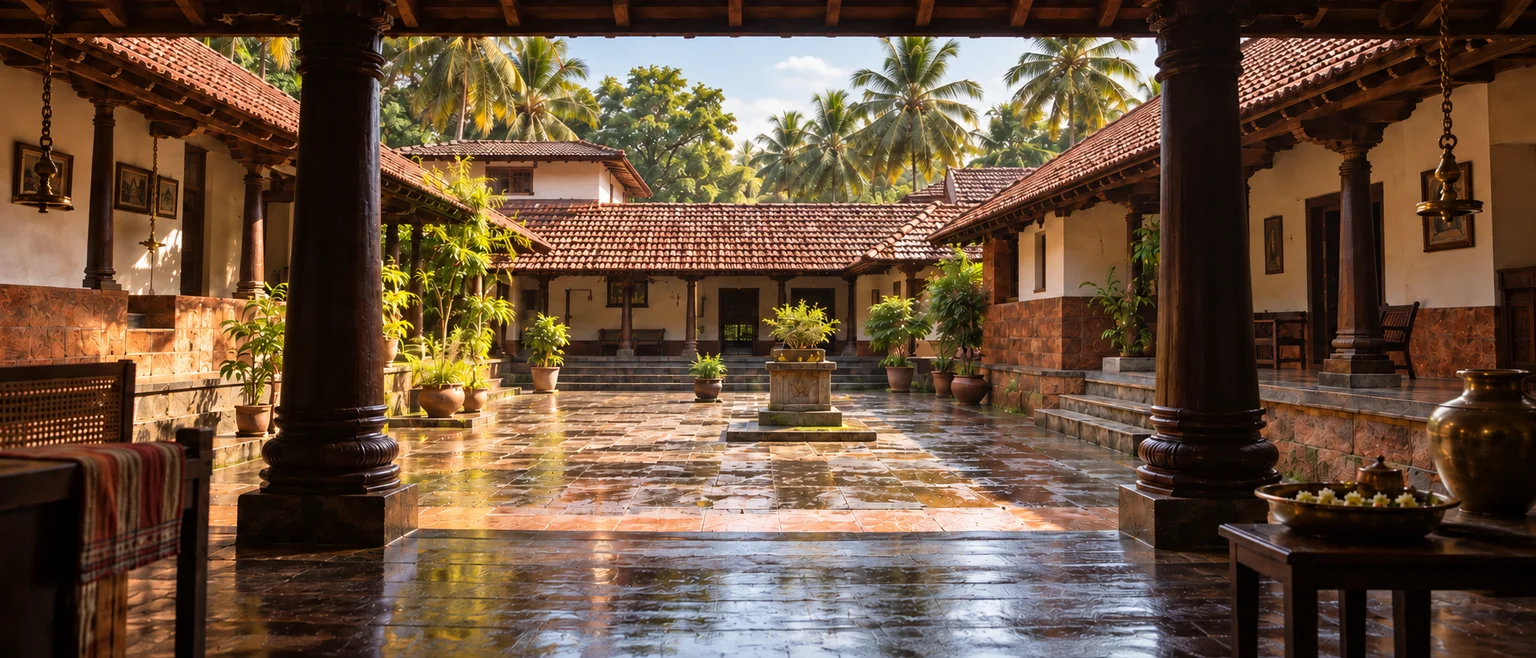
For readers interested in architecture, guthu houses offer a related subject. A courtyard can be a domestic space, a meeting place and part of a network of ceremonial duties. Understanding the building involves following those uses, not just identifying its roof, pillars and carved woodwork.
Preparation is part of the ritual
The striking moment in a photograph usually depends on work that began earlier: arranging the space, caring for regalia, preparing materials, assembling musicians and helping a ritual specialist dress. These tasks have their own knowledge. They are not simply backstage activity of the kind a visitor might expect at a theatre.
Pradeep KS's Sahapedia field documentation records preparations at sites near Mangaluru, including face painting, ornaments, plant materials and assistance by relatives. It identifies the tembere drum and the recitation of narrative material during preparation. The photographs belong to particular visits and should be read as evidence of those settings, rather than as a checklist every shrine must reproduce.
Paying attention to preparation changes how an observer reads the finished appearance. An ornament may identify a role; a material may connect the body to the surrounding landscape; an assistant's action may reflect years of shared practice. The image becomes more informative when the people doing this work are named alongside the person most visible in the frame.
Songs give the occasion a narrative world
A ritual has a story before it becomes a spectacle. Paddana traditions carry accounts of origins, journeys, encounters and claims associated with daivas. The narrative can explain why a particular place matters or why a relationship carries an obligation. Learning a little of that story makes an unfamiliar name or gesture easier to follow.
The song and the visible action need not convey identical information at every moment. A listener might hear a place name, a kinship term or an account of a difficult encounter while the body and music establish another part of the occasion. A short video that removes the words can leave the viewer with movement but little sense of its setting.
The garden, the journey and the protected tree in the Panjurli narrative show how this works. A daiva is encountered through particular actions, rather than introduced only by an abstract definition. The guide to paddana oral epics follows the connection between a singer, the story being voiced and the occasion that gives it meaning.
Speech, petitions and the expectation of justice
Many accounts of daiva worship describe exchanges in which people seek blessings, guidance or a response to a grievance. Within the observance, devotees understand the voice as carrying the daiva's authority. That belief is central to the occasion and can be described clearly without asking every reader to share it.
Ishii's research examines how shrine participants move between customary responsibilities and modern institutions. Her Perar study includes disputes about management as well as communication within ritual. This is more complex than a simple story in which an old form of justice disappeared when courts arrived, or one in which ritual replaced the legal system.
The same words can carry different weight according to who speaks and who hears them. An exchange may recall a promise, affirm a relationship or ask for an unresolved matter to receive attention. Seeing speech as part of the ritual helps explain why people remain engaged after the most visually dramatic passage has ended: the gathering also creates an occasion for listening and response.
Land, animals and sacred responsibility
Daiva traditions often bring cultivated places into relation with forests, animals and forces beyond human control. Ishii's article on wild sacredness examines these relationships in a social and ecological setting. Her interpretation is a useful alternative to viewing every action only as a symbol of human rank, or treating the landscape as a decorative background.
The connection is especially visible in questions surrounding Panjurli, whose boar form points toward the difficult proximity of cultivated ground and wild animals. A field can sustain a household while remaining vulnerable to things the household cannot command. Sacred narratives provide one language for thinking about that vulnerability and the responsibilities that accompany use of the land.
This is an interpretive reading, not a claim that every ritual contains a ready-made modern environmental policy. The productive question is specific: which landscape, animal, boundary or cultivated place appears in this narrative? Following those details makes the relationship tangible and allows different local accounts to remain distinct.
The people who sustain the observance
Landholding families, ritual specialists, musicians, craft workers and other participants can have different forms of authority. Describing only the sponsor misses the knowledge carried by performers. Describing only the most photographed performer misses the people who maintain objects, remember songs, arrange hospitality and carry out less visible work.
Junnonaho's fieldwork in Belma and Ishii's work in Perar show why a historical account must consider social hierarchy as well as religious participation. A moment of ritual authority does not by itself prove that everyday inequality has disappeared. Equally, a person's skill and sacred responsibilities should not be reduced to their position in a caste classification.
The division of responsibilities gives the gathering its depth. Knowledge of a narrative, skill in making an object and responsibility for a shrine are different contributions. A person may depend on another participant's knowledge even while occupying a different position in everyday life. The observance brings these relationships into action, which is why neither the sponsor nor the ritual specialist can fully explain the occasion alone.
How to recognise the occasion you are seeing
Bhuta kola, Yakshagana and Theyyam may all be encountered in discussions of the southwest coast, but the names are not interchangeable. Yakshagana is a theatrical performance tradition with its own ensemble and dramatic conventions. Theyyam has related regional religious contexts in northern Kerala, while the University of Tübingen's collection explicitly distinguishes its documentation of Teyyam and Bhuta traditions.
For a first visit, find out the daiva's name and the host's name before the event. Follow the spaces available to visitors, and keep recording equipment out of preparation areas unless permission has been given. These simple details help a visitor participate without interrupting the work around them.
The difference becomes clearer when you consider what brings people together. At a theatrical programme, the audience follows a dramatic story and its interpretation by artists. At a daiva observance, participants may also be fulfilling inherited duties, seeking a blessing or renewing a relationship with a sacred presence. Recognising that purpose helps a visitor understand the gathering beyond the shared visual elements of costume, music and movement.
Research notes
Miho Ishii: Exchange with the Spirits; Miho Ishii: Wild Sacredness; Martti Junnonaho: Bhuta Worship in Belma; Sahapedia: Dance of the Spirits; University of Tübingen: Bhutas and Teyyams Collection.
Research checked 7 October 2026. Our editorial approach.