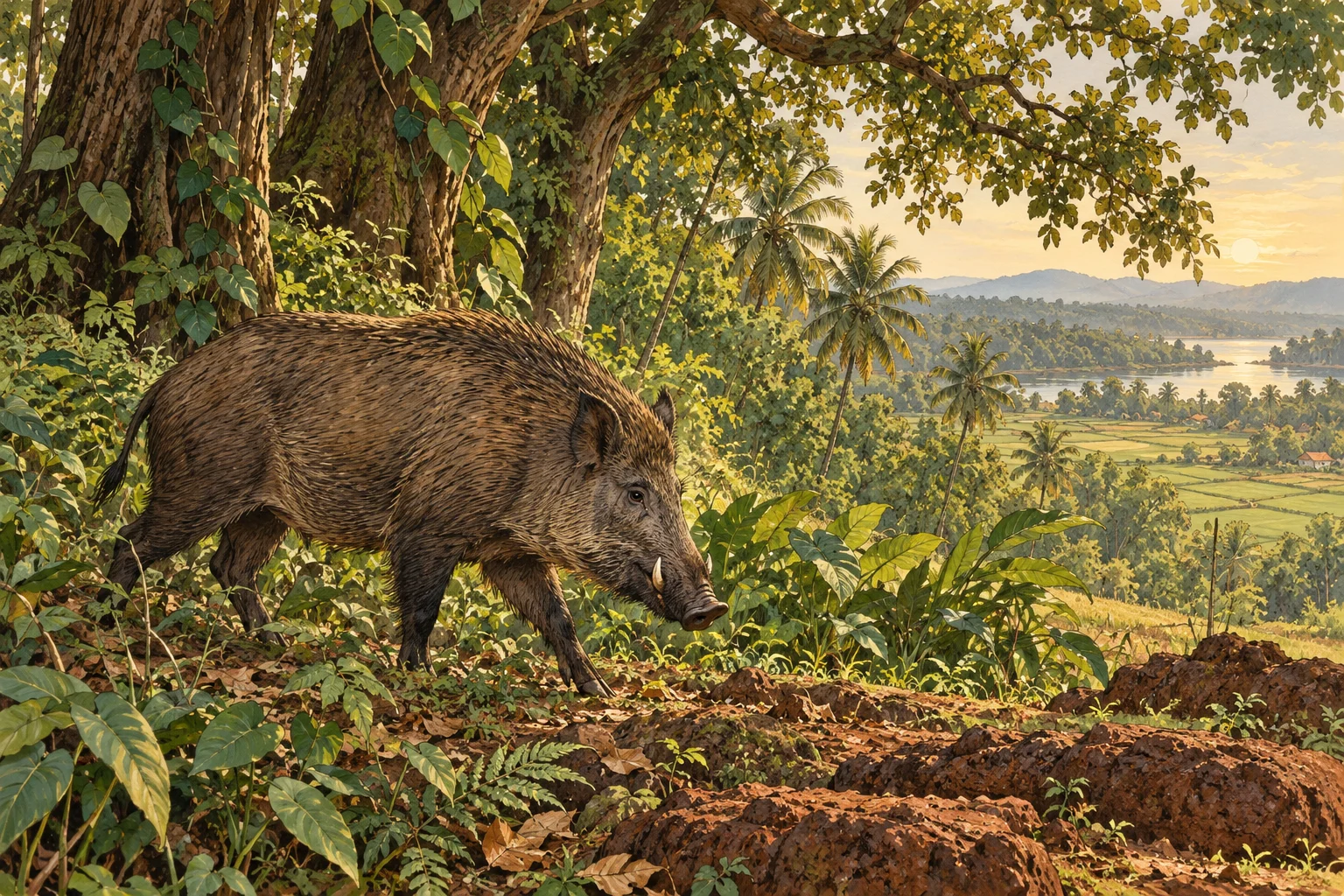
Who is Panjurli?
Panjurli is a daiva associated with the wild boar in the religious traditions of Tulunad. The boar face is a recognisable form in surviving ritual metalwork, while songs and local accounts give Panjurli relationships with places and people. To understand the tradition, it helps to bring those two kinds of evidence together: the object that can be seen and the narrative that explains an obligation.
Museum collections establish that Panjurli imagery was documented well before the recent international attention brought by cinema. The Philadelphia Museum of Art, for example, catalogues a boar-headed Panjurli object to approximately the eighteenth or nineteenth century. That is a date assigned to an object, not a precise date for the beginning of worship.
Readers arriving through Kantara can use the film as a starting point for curiosity. A fuller account follows the name into oral narratives, metal craft and particular shrines. The broader guide to daivaradhane, kola and nema explains the setting in which such relationships become part of a ritual occasion.
Reading the boar face in a documented object
The National Crafts Museum catalogues a Panjurli mask from Karnataka with a boar face, an eleven-hooded snake above it and an umbrella at the top. Its record also notes chains at the back. These are concrete details of one object. They give a reader more to examine than the general description of an impressive or fierce mask.
Start with the different parts: the animal face, the framing ornament, the upper structure and the means of holding or attaching the piece. Each belongs to the material design. The record identifies the boar association, but it does not supply a complete ceremonial biography of the object or prove that every Panjurli representation has the same arrangement.
The combination of a boar face, serpent canopy and umbrella also shows that a ritual object need not be a naturalistic portrait of an animal. It brings several visual elements into one form. A viewer can recognise the boar without assuming that every feature belongs to boar anatomy, or that a museum object explains the complete appearance and movement of a living observance.
A historical story begins in a divine garden
A Panjurli narrative published in the Indian Antiquary in 1896, from A. C. Burnell's collected papers, begins with pigs damaging Isvara's garden. Parvati intervenes when he wants to kill them. The story then places the animals in the forest and establishes Panjurli as a being to whom village worship will be offered.
This is a historical recording of a narrative, not an eyewitness account of a supernatural event. It is also one transmitted version. The publication preserves a particular route through the story, including its collectors, translation and colonial editorial language. Its old title uses a dismissive English description of the religion that is not a suitable label for present-day devotees.
The opening brings cultivated space and wild appetite into the same scene. A garden is ordered and cared for; pigs can undo that work. The narrative moves from damage and punishment toward a relationship in which the being receives recognition. That movement provides a useful way to read the story without pretending it is a scientific explanation of why worship began.
The traders, the jackfruit tree and the missing cattle
The same recorded version continues with brothers who try maritime trade and later turn to cattle. Travelling back from the Ghats, they stop beneath a jackfruit tree. Herdsmen warn them that its fruit is protected by Panjurli. The travellers dismiss the warning, eat the fruit and move on. Their cattle subsequently disappear.
In the narrative, the loss is explained as the result of disregarding the warning and taking what was not theirs. They arrange to acknowledge the daiva, and the cattle return. The story joins an apparently small roadside encounter to a lasting religious relationship: a tree, its fruit, a warning, a refusal and the consequences of that refusal.
These episodes make the account more particular than the phrase nature worship. Trade, travel, ownership, food and the treatment of another person's words all matter. The travellers do not encounter an empty landscape. They move through places already claimed, cared for and understood by others. Reading the episode this way draws attention to its ethical questions while leaving its sacred meaning with the people who tell it.
Why the singer matters to the story
The historical narrative includes another memorable episode. A ritual specialist named Kantu is asked to perform but says that he does not know the daiva's origin story. The account answers this problem through a wonderful narrative device: a squirrel supplies a song that he learns. A pig's face provides a model for appearance.
This is an episode within the legend, not an instruction for present-day ritual preparation. Its interest lies in what the narrative makes necessary. Clothing and payment are not enough; the person must also have the story. Knowledge has to be acquired before the encounter can be properly voiced.
That gives readers a reason to pay attention to singers as well as masks. A beautiful object can remain silent about the place names, promises and relationships that a sung account preserves. Our introduction to paddana oral epics follows this connection between narrative knowledge and performance, and explains why a recording should retain the singer's identity and the context in which it was made.
Metal craft is a continuing practice
Panjurli representations are also part of living craft. Serendipity Arts documents the work of Rajesh T. Acharya, a metal craftsperson trained within a Vishwakarma family and through further professional apprenticeships. Its display list includes a standing Panjurli boar and Panjurli with a rider, alongside other bhuta-related works.
The named maker and different objects help correct an easy misunderstanding: ritual metalwork is not simply a collection of anonymous things left behind in the past. It can involve training, commissions, choices of form and work for different settings. An object in an exhibition, a newly commissioned piece and an item held for worship may look related while having different histories of use.
When looking at craft, distinguish the maker's skill from the object's ritual status. A workshop photograph can show a process; an exhibition label can identify a work; neither automatically establishes where it has been consecrated or how it is used. Those histories become available through the people responsible for the object, rather than through its appearance alone.
Panjurli, Varaha and questions of identification
A boar form naturally prompts comparisons with Varaha, the boar incarnation of Vishnu. Some catalogue descriptions use Varaha in naming a Panjurli mask. The National Crafts Museum's title is one example. The relationship between names in a catalogue should be noticed, but it does not make the entire body of Panjurli narrative identical to a single pan-Indian account of Varaha.
The nineteenth-century narrative itself brings Panjurli into relationships with more than one divine figure. This is a better reason to read the story closely than to impose a simple choice between completely separate religions or complete equivalence. Names, affiliations and explanations can change across tellings and settings.
When comparing two accounts, identify the point of comparison. Is it the animal form, a divine relationship, a shrine name or a particular narrative episode? That question makes the comparison answerable. Two objects may share a boar face while the stories told about them differ in place, protagonists and the obligations they explain.
From a striking image to a fuller understanding
A useful first reading of Panjurli can follow three connected tracks. Look at a well-described object to understand its visible form. Read a credited narrative to discover the encounters and promises surrounding the daiva. Then place both within the local world of worship, where people maintain relationships across generations.
Each track supplies something the others cannot. A metal mask records craftsmanship; a narrative records a sequence of actions and meanings; a shrine history records a continuing relationship with a place. Together they resist the temptation to reduce the tradition to a costume, a single moral lesson or a plot device borrowed from a film.
The boar association becomes especially interesting when these records are read together. The garden story brings an animal into conflict with cultivation; the traders encounter a protected tree; Kantu needs a song before he can perform. These are different encounters with recognition and responsibility. They give Panjurli a place in a social landscape of work, movement and relationships, extending well beyond the instant recognition of a boar face.
Research notes
National Crafts Museum: Panjurli Mask; Philadelphia Museum of Art: Panjurli; Serendipity Arts: Bhuta Brass; Indian Antiquary, 1896: Panjurli Narrative; Indian Antiquary, 1896: Narrative Continuation; Indian Antiquary, 1896: Ritual Episode.
Research checked 7 October 2026. Our editorial approach.