Begin with a city, not a collection of monuments
Mangaluru’s history becomes clearer when its landmarks are placed in conversation. The harbour explains connections with places beyond the coast. Places of worship reveal different forms of patronage and community life. Educational institutions record another kind of urban growth. Tiles and domestic buildings bring the story back to the people who made, maintained and inhabited the city.
The Dakshina Kannada administration identifies Mangaluru as a longstanding trading centre and records important changes of rule, including Hyder Ali’s conquest in 1763 and British control in 1799. Those dates help establish a framework, but they do not describe everything that happened between them. A city is more than its succession of rulers. Its history also includes work, migration, language, devotion and the changing relationship between inland settlements and the sea. This guide selects places that illuminate different parts of that larger story.
The old port and the new port tell different stories
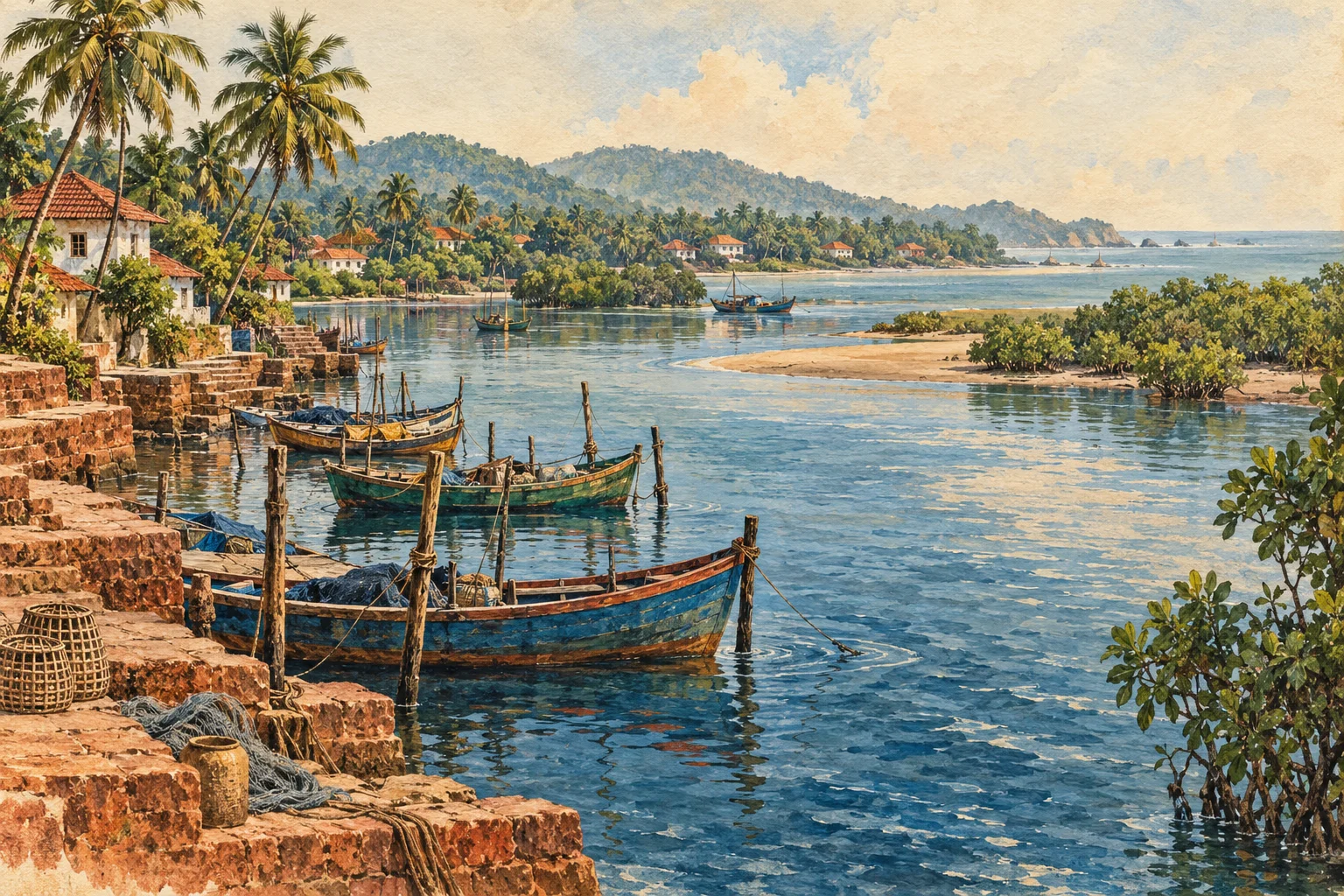
The New Mangalore Port Authority places the old port, or Bunder, at the meeting of the Gurupura and Netravati rivers. Its account explains that the constraints of the old harbour led to the development of a new port at Panambur. The harbour project was established in 1962, maritime construction began in 1968, and the new port was declared a major port in 1974 before its formal inauguration in 1975.
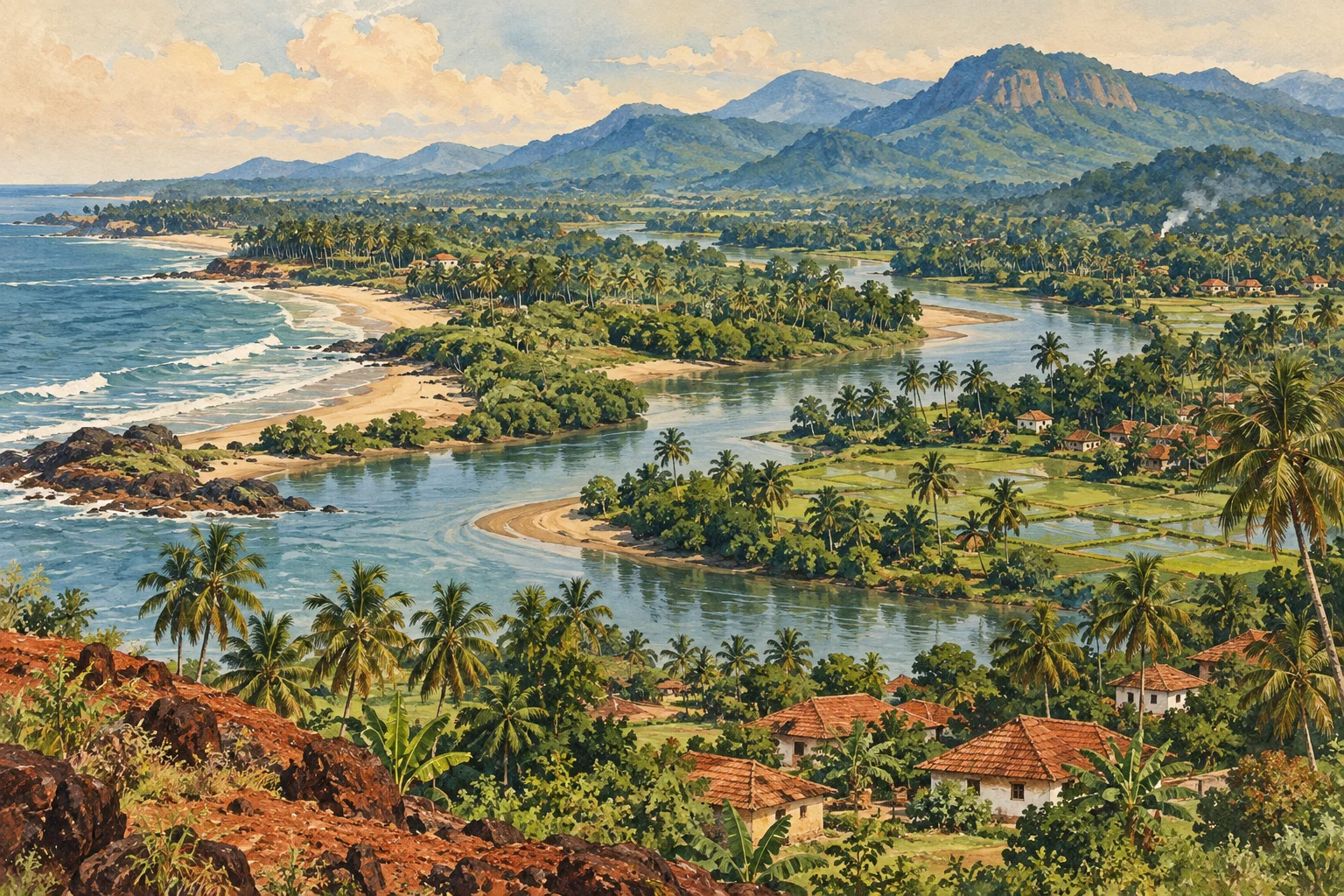
Bunder and Panambur therefore mark different stages of the city’s maritime development. The older estuarine harbour belongs to the confluence landscape; the modern major port occupies a separate site farther north. Both matter to Mangaluru, but they should not be treated as two names for the same place. Our rivers and estuaries guide explains the water geography behind this urban story.
Kadri: read the layers without forcing a simple origin story
Kadri Manjunatha is one of the city’s most important places for examining a layered sacred past. Karnataka Tourism highlights the bronze image of Lokeshwara and discusses Buddhist associations alongside the present Shiva temple. It also identifies spring-fed tanks and laterite caves within the broader complex. These are distinct features, each with its own history and meaning.
The useful insight is not that one short label can explain Kadri. It is that an object, a building and a living religious institution may preserve different historical layers. A bronze can raise questions about earlier worship and patronage even when a visitor encounters the site through current temple practice. A responsible account should distinguish the date assigned to a particular object from the age of the whole complex. Kadri is therefore especially valuable for readers interested in how material evidence and continuing devotion can occupy the same place.
Mangaladevi and the city’s remembered name
The Mangaladevi temple stands in Bolara. The district administration connects the city’s name with this shrine, while the temple’s own account places it within Mangaluru’s religious landscape. That association is central to how the city explains itself. It deserves attention as a local historical and sacred tradition, without assuming that a name explanation proves every detail of a foundation narrative.
Published tourism accounts do not consistently give the same century for the temple’s foundation. This guide therefore does not resolve the discrepancy by selecting the more attractive date. The stronger shared point is the temple’s importance to the city’s identity and the association of Mangaladevi with its name. For a heritage reader, the place offers something different from Kadri: an opportunity to consider how a shrine becomes part of urban memory. Its significance includes the name people use, not only the age that a guidebook assigns to a structure.
St Aloysius: distinguish the institution, chapel and paintings
St Aloysius’ own chronology dates the establishment of the college to 1880, the inauguration of the chapel to 1887 and the completion of Antonio Moscheni’s chapel paintings to 1901. These are three separate milestones. Collapsing them into one construction date loses information and helps explain why brief summaries of the chapel sometimes conflict.
The interior brings together biblical scenes, apostles and saints, painted across the walls and ceilings. The programme belongs to a functioning Catholic place of worship, and the institution also describes its restoration history. The chapel’s published visitor instructions prohibit photography and video inside. Seeing the paintings in that setting means encountering art, religious practice and conservation together.
Kudroli and the history of social reform
The district’s places-of-interest account associates Kudroli Gokarnatheshwara Temple with Narayana Guru, whom it identifies as a philosopher, saint and social reformer. This connection offers an important change of emphasis. Heritage includes institutions associated with social ideas and community aspiration, as well as those valued primarily for antiquity or architectural style.
Placed beside Kadri, Mangaladevi and St Aloysius, Kudroli helps prevent the city’s religious history from becoming a single timeline of older and newer buildings. These places have different institutional contexts. Their value cannot be ranked by age alone. For community history, the questions of who created access, who organised support and how a place entered public life are as important as its exterior. The Tulunad overview situates such histories within a region of several communities, languages and religious traditions rather than assigning the whole city to one cultural narrative.
The tiled roof also belongs to industrial history
The Basel Mission archive preserves a trade catalogue identifying its South Canara and Malabar tile works as established in 1865. This is a useful primary trace: the familiar roof tile also belonged to a commercial system of manufacture, product design and distribution. It was not only an anonymous feature of a picturesque coastal house.
This industrial history gives the tiled roof a second meaning. On a home it is part of the building’s material character; in the catalogue it is a manufactured product designed for a market. The reference to both South Canara and Malabar also shows an enterprise extending along the coast. Mangaluru’s familiar red roofs connect domestic architecture with production and trade.
Pilikula makes domestic heritage easier to read
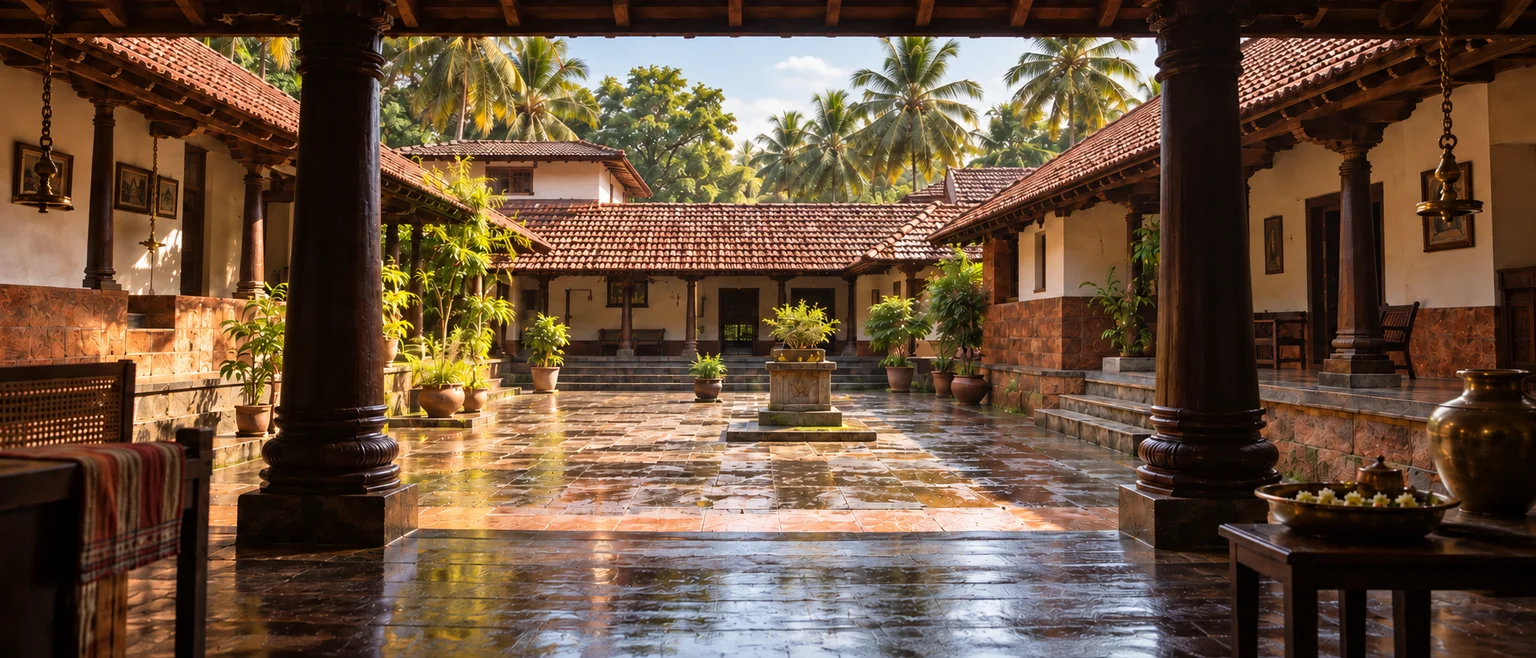
Karnataka Tourism presents Pilikula’s heritage village as a setting for traditional crafts and a Guthu Mane, with carved timber and household objects among its interpretive features. It is a useful complement to a city-centre heritage reading because it turns attention towards domestic space and making. Furniture, vessels and building parts can reveal everyday arrangements that a monument list leaves out.
A reconstructed or curated setting should be described honestly. It can bring related material into view, but its arrangement is not evidence that every household in the region looked the same. Nor does it replace the history of a named family house. Used carefully, Pilikula provides a vocabulary for recognising materials, crafts and spatial relationships elsewhere. Readers who want to explore that subject can continue with Guthu houses in Tulunad, where architecture is considered alongside household life, social context and the responsibilities of preservation.
Choose a thread, then connect the places
These landmarks work best as several possible readings of the city. A maritime reading begins with the old and new ports. A sacred-history reading compares Kadri, Mangaladevi, Kudroli and St Aloysius while respecting their different traditions. A material-history reading connects roof tiles, domestic buildings and Pilikula’s collections. None requires pretending that every site belongs to one period or one community.
The differences are part of the city’s character. Bunder and Panambur centre the waterfront; Kadri and Mangaladevi connect objects, worship and urban memory; St Aloysius adds education and painting; Kudroli brings social reform into view. Pilikula and the tile industry return the story to the materials and skills used in everyday buildings. Together they reveal a city repeatedly shaped by water, work, faith and education.
Research notes
Dakshina Kannada district: About District; New Mangalore Port Authority: Brief History; Karnataka Tourism: Kadri Manjunatha Temple; Dakshina Kannada district: Places of Interest; Mangaladevi Temple: institutional website; St Aloysius: History and Milestone; St Aloysius: Chapel; Basel Mission Archives: tile-works catalogue, BMA QU-30.017.0070; Karnataka Tourism: Pilikula Village Nisargadham.
Research checked 7 October 2026. Our editorial approach.