What happens at a Kambala race
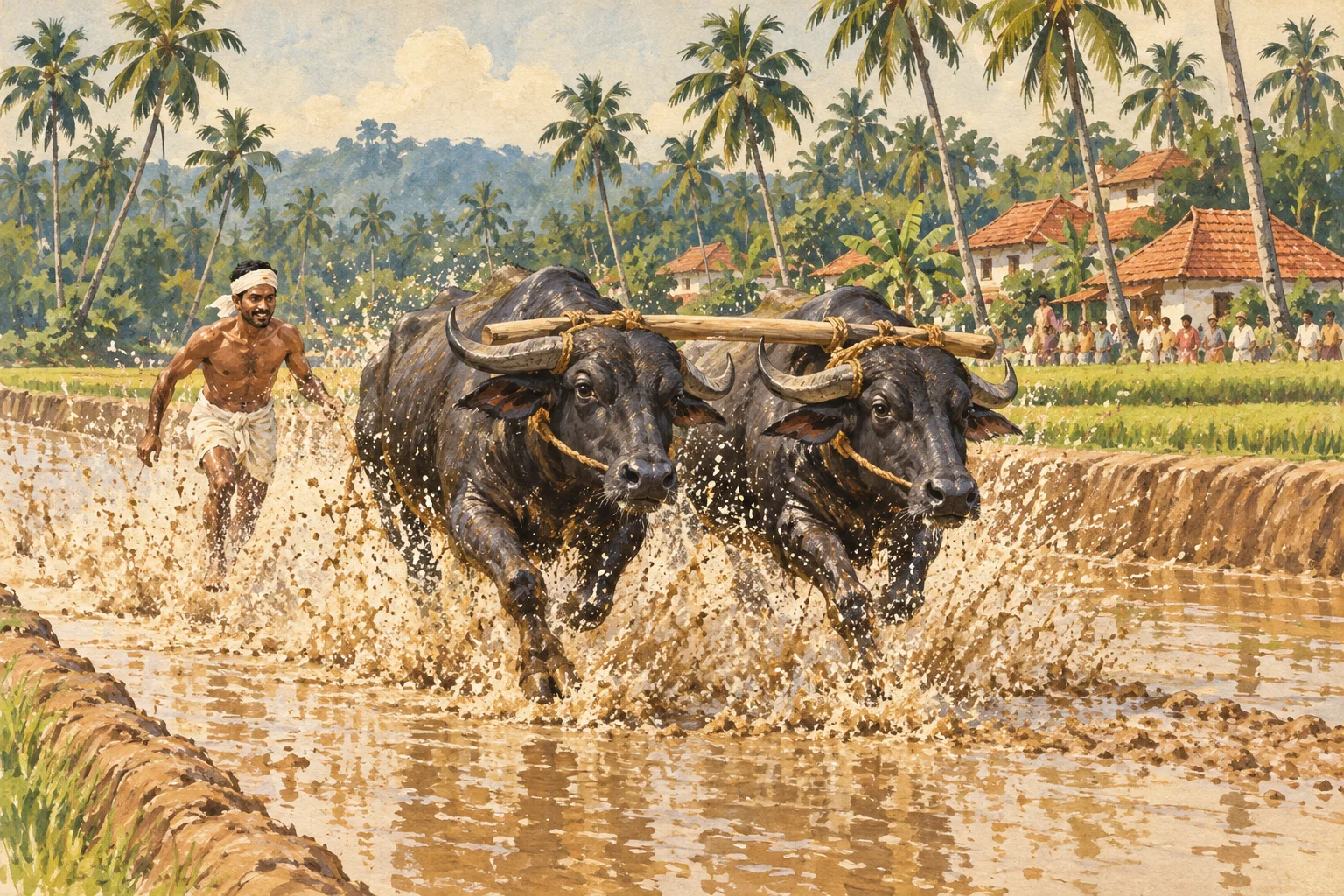
Kambala is a buffalo-racing tradition associated with coastal Karnataka and the wider Tulu cultural region. Pairs of buffaloes travel along a waterlogged track with a runner or rider, depending on the event. In a familiar competitive arrangement, two parallel tracks allow teams to race alongside each other. The animals, the person guiding them and the equipment form a working unit.
The first thing a new spectator should identify is the category. Some competitors run behind the buffaloes; others ride a board drawn through the water. Certain contests emphasise speed, while Kane Halage involves the height of the water thrown up. Understanding that distinction makes the action far more legible than treating every dramatic splash as the same race.
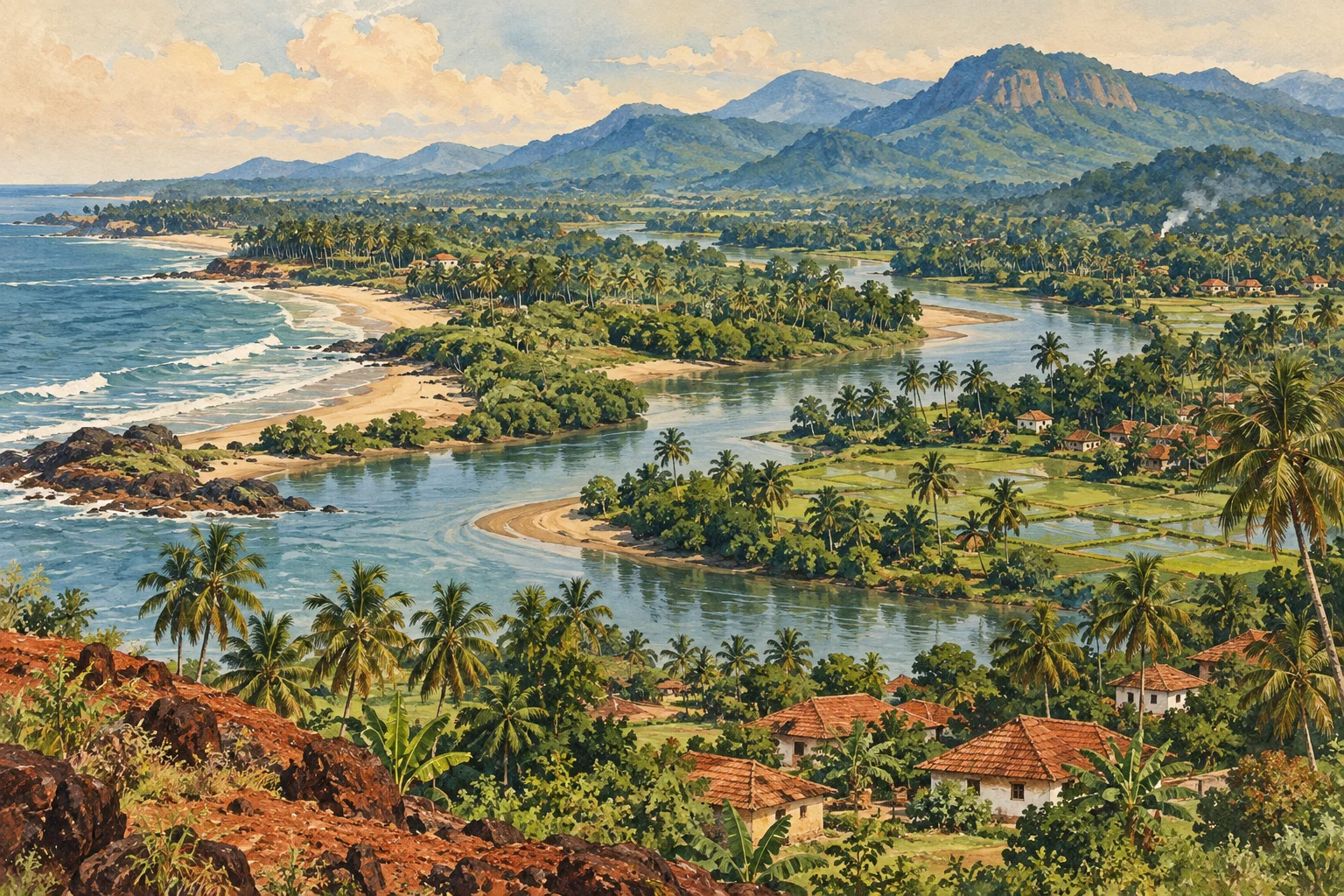
Dakshina Kannada's district administration describes Kambala as a farmers' sport, and Kasaragod's cultural overview also includes it among Tulu traditions. Its geographical story therefore belongs to a connected coastal region. Our Tulunad guide explains that setting across present-day district and state boundaries.
Why the paddy field matters
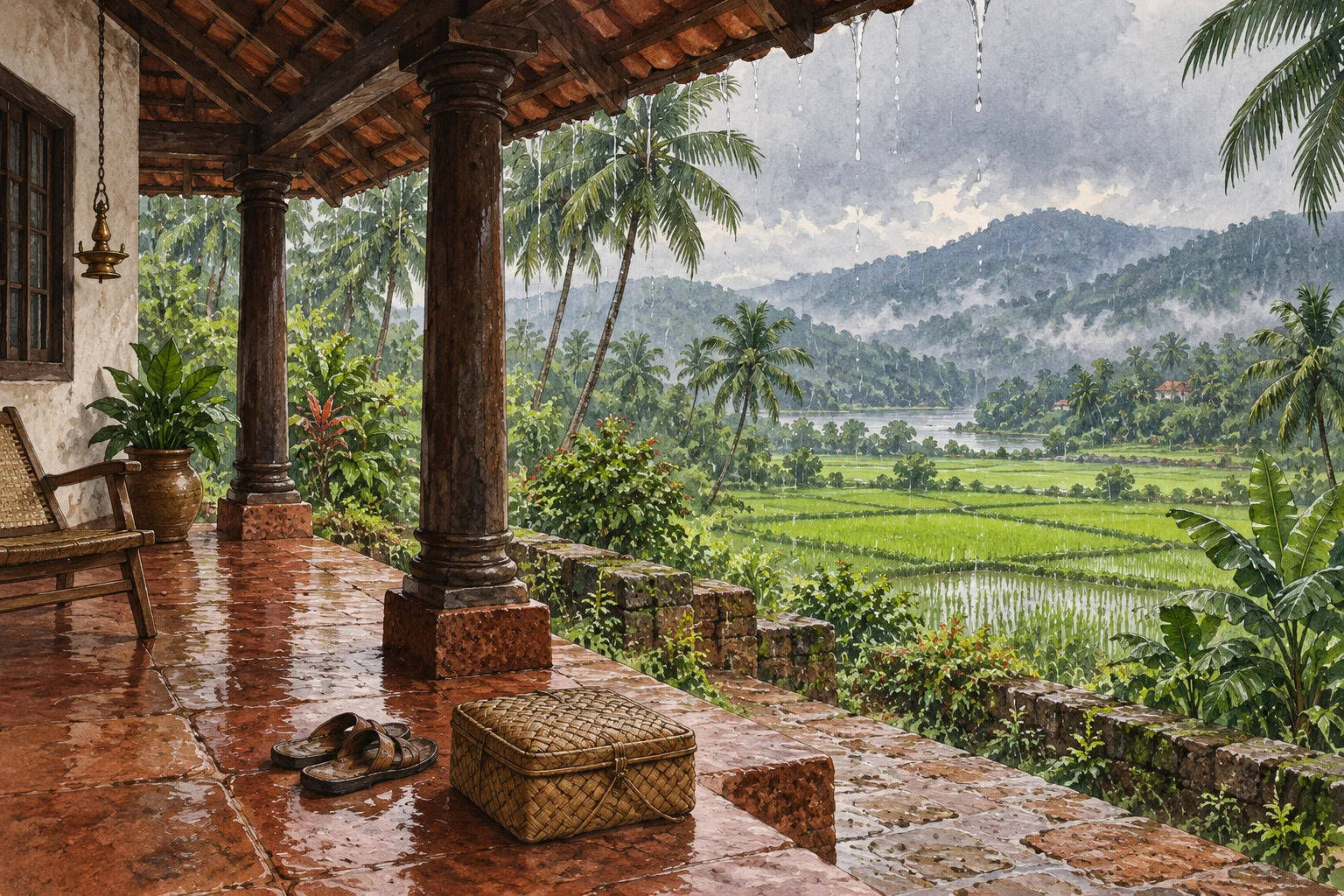
Kambala's wet surface is part of its agricultural connection. Karnataka Tourism places the competitive season after the paddy harvest and describes a broad November-to-March period. This is a seasonal guide, not a promise that a particular venue will hold a race on the same weekend every year. Modern competitions also use prepared tracks rather than simply any available field.
A useful historical reference appears in J. Sturrock's 1894 South Canara district manual. In its agriculture chapter, it notes that some large Bunt landholders maintained racing buffaloes. The passage sits beside descriptions of agricultural animals and implements. It establishes a documented nineteenth-century connection between farm estates and racing animals; it does not establish the first Kambala or make participation exclusive to one community.
Reading the race through this setting changes what stands out. The wet track, the paired animals and the vocabulary of ropes, ploughs and boards are connected to a landscape of cultivation. Kambala has become a competitive spectacle while retaining these visible links to the working world from which it developed.
Negilu and Hagga: the running categories
Negilu and Hagga are two names a first-time spectator is likely to hear. Negilu refers to a plough, and the racing arrangement uses a light plough-like implement. Hagga refers to a rope. In both forms, the person guiding the buffalo pair runs behind the animals rather than standing on a drawn board.
The difference in equipment matters. Look at the connection between the pair and the runner, then watch the start and the transition into a coordinated run. Two powerful animals must travel together, and the human participant has to keep position on a difficult surface. The event cannot be understood by looking at the runner's feet alone.
The Indian Express's account of the 2023 Bengaluru event records junior and senior divisions for these categories. An event programme may therefore contain more competition headings than the four broad category names suggest. Divisions, qualifying runs and finals should be read within that programme; a prize in one class is not automatically the overall result for every type of Kambala.
Adda Halage and Kane Halage: understand the board
In Adda Halage, the participant stands on a horizontal board drawn by the buffaloes. Kane Halage also uses a board, with openings through which water rises as it travels along the wet track. The Indian Express's explanation identifies water height as the defining feature of the latter event. This is why photographs of a great spray cannot by themselves tell you who produced the fastest timed run.
The board changes the spectator's view of skill. Along with the movement of the buffaloes, watch how the rider maintains balance and alignment. The water is part of what the equipment moves through and, in Kane Halage, part of what the event measures. A brief explanation before the run can make a seemingly chaotic burst of mud and water intelligible.
These categories also show why a single description such as all jockeys run, or all jockeys stand on planks, is misleading. Both arrangements exist within Kambala. Learning their names is the quickest way to distinguish them in a programme, a photograph or a conversation with someone who follows the sport.
The buffaloes have a history beyond the racetrack
Research on South Kanara buffaloes supplies a useful agricultural perspective. P. Kathiravan and colleagues describe animals associated with the region's wet-field work as well as milk production and racing. Their study belongs to livestock research, not to a ranking of Kambala competitors. It helps explain why buffaloes are part of the region's farming history rather than appearing only as sporting animals.
The Central Institute for Research on Buffaloes' South Kanara profile describes the regional population and its management. It discusses housing near human dwellings, grazing, paddy straw and other feed resources. Those observations concern the population studied and should not be used as a universal care manual for every racing animal or as current population totals.
The distinction is useful for visitors. A striking animal at a competition is an individual with its own owner, history and care needs. A regional breed profile describes broader characteristics. Neither a glossy coat nor a famous team name, by itself, establishes the health, welfare or pedigree of every buffalo on the track.
The work before the starting line
A race lasts briefly; preparation occupies much more time. In The Week's 2020 interviews, Kambala coach Gunapala Kambada described training that included handling, rope work, physical preparation and learning the sport's equipment. Owner Satishchandra Salian spoke about preparing buffaloes for crowds and unfamiliar surroundings. These are useful first-person accounts of the work behind a public run.
Srinivas Gowda also credited the buffaloes and their owner when discussing his own success. That emphasis helps a spectator see the team around a recognisable runner. Ownership, daily care, training and participation are distinct roles, even where one person contributes to several of them. A result announced with only the runner's name can leave much of that work invisible.
Care remains relevant on race day as well as in preparation. Space for animals and handlers, water, rest and veterinary attention are practical matters. A spectator can contribute by keeping clear of working areas and following the arrangements around the track. Close access to a large animal is not necessary for an attentive view of the event.
Why a Kambala time is not a sprint record
Kambala attracted wider attention when times associated with Srinivas Gowda prompted comparisons with track sprinting. The Week's interviews include both Gowda's acknowledgement of the difference and sports officials' explanation that adapting to a track would require specific training. His Kambala achievement can be appreciated without claiming an equivalent result in another sport.
A simple calculation illustrates the problem. Dividing distance by time gives an average speed. Scaling that average to a different distance assumes the same conditions and pattern of movement. It does not account for the start, acceleration, track surface, timing method, equipment or the interaction with buffaloes. A number produced this way is an estimate under assumptions, not a measured hundred-metre performance.
The useful comparison is within a clearly identified competition and category. The track length, timing arrangement and official result give a time its meaning. Looking for those details respects Kambala as a sport with its own demands, rather than valuing it only through a borrowed comparison with a famous athlete.
From coastal grounds to a city audience
The November 2023 Bengaluru Kambala offers a documented example of the sport reaching an urban audience. Jithendra M's Indian Express photographs record the prepared slush tracks at Palace Grounds, spectator galleries, large viewing screens and several categories. The venue made a coastal competition visible to people who might not otherwise travel to a village event.
That setting also raises an interesting question about what travels with a tradition. Animals and competitors can move to a new venue, but the event still depends on knowledge of equipment, handling, categories and the organisation of a long programme. A city audience sees the most dramatic moments more clearly when that knowledge is explained alongside them.
For a first visit, identify the event, venue, date and category from its current notice, then plan enough time to watch several runs. Stay within the spectator area and listen to the announcements. Pairing the experience with Yakshagana or an account of Aati's seasonal traditions reveals a broader coastal culture in which performance, farming and community gatherings remain closely connected.
Research notes
Karnataka Tourism: Kambala; Dakshina Kannada district: Tourism and regional culture; Kasaragod district: Culture and heritage; J. Sturrock: South Canara district manual, 1894, agriculture chapter; P. Kathiravan and colleagues: Survey and characterization of South Kanara buffaloes in India; ICAR Central Institute for Research on Buffaloes: South Kanara; Akram M, Indian Express: Kambala categories and Bengaluru, November 2023; Jithendra M, Indian Express: Bengaluru Kambala photo report, 2023; Prathima Nandakumar, The Week: Interviews with Srinivas Gowda, his coach and SAI officials, 2020.
Research checked 7 October 2026. Our editorial approach.